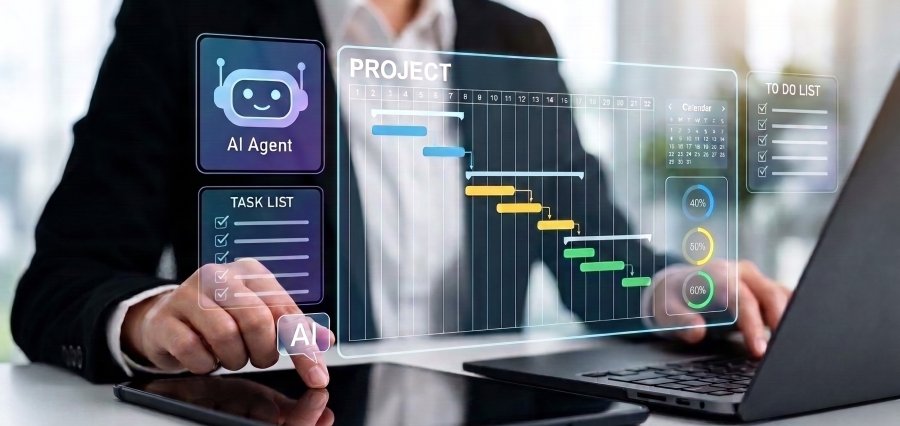
Most business leaders have experienced the same quiet frustration. A talented team member spends three hours pulling data from five different systems to prepare a report that takes ten minutes to read. A sales rep manually updates CRM records after every call instead of making the next one. A customer service agent answers the same question for the fortieth time that day. The work is necessary. But it is not the work these people were hired to do.
This is the gap that AI agents for business are designed to close. Not by replacing the people doing the work, but by handling the repetitive, time-consuming steps that sit between human decisions, freeing teams to focus on what actually requires judgment, creativity, and relationship.
This blog discusses what AI agents for business are, how they work, what AI task automation looks like in practice, and why businesses across industries are moving quickly to adopt them.
What Makes an AI Agent Different
Most people are familiar with AI tools that respond to questions. You type something, the AI replies. That is conversational AI, and it is useful. But it is reactive. It waits for input.
An AI agent operates differently. Give it a goal, and it figures out the steps needed to reach it, executes those steps using the tools available to it, checks its own progress, and adjusts when something does not go as planned. It does not wait to be asked what to do next. It decides.
This distinction matters enormously for business. AI agents for business can deal with an entire process independently, operate within different systems, make decisions at each stage of the process, and seek human intervention only when it is really needed.
How AI Task Automation Actually Works
AI task automation by the agent in AI happens through an endless loop, which only stops when the objective is achieved.
The agent begins by receiving information about its environment. This might include a new email, entry into the database, customer inquiry, or information from other systems. It then reasons about what needs to happen next, breaks the goal into smaller steps, and begins executing them using whatever tools it has access to. Search the web. Query a database. Send an email. Update a record. Call an API. Run a calculation.
The process repeats after every step, depending on whether the individual has taken any steps closer to the goal. The process will continue until completion or the individual realizes that he needs human intervention.
What makes this approach genuinely powerful is that the loop runs at a speed and scale no human team can match. One agent can process hundreds of tasks simultaneously. It does not get distracted, tired, or inconsistent.
Where AI Agents for Business Are Making the Biggest Impact
Sales and CRM
AI agents for business are already transforming sales operations. An agent can monitor incoming leads, research each company and contact, draft personalised outreach, schedule follow-ups, update the CRM, and flag high-priority opportunities, all before a sales rep has finished their morning coffee. The rep picks up the conversation at the point where human judgment actually adds value.
Customer Support
A well-designed AI agent does not just answer questions. It looks up the customer’s history, checks order status, processes a refund, sends a confirmation, and closes the ticket, end to end, without involving a human agent for routine cases. Human support teams handle the genuinely complex or emotionally sensitive situations where their involvement makes a real difference.
Finance and Operations
In finance and operations, agents handle invoice processing, categorising expenses, reconciliations, and anomaly detection with a precision that human effort cannot match
HR and Recruitment
Screening applications, scheduling interviews, sending candidate updates, and preparing hiring manager briefings are all tasks that AI agents for business now handle routinely. Recruiters spend their time on conversations and decisions rather than administration.
Market Intelligence
An agent tasked with competitive monitoring can track competitor websites, pricing changes, product launches, and industry news, then deliver a structured briefing on a set schedule. The team gets the intelligence without anyone spending hours gathering it.
Single Agents and Multi-Agent Systems
A single AI agent handles one domain or workflow. A multi-agent system coordinates several agents working in parallel or in sequence, each specialising in a different part of a larger task.
A business might deploy a research agent that gathers information, an analysis agent that processes it, a writing agent that drafts a report, and a distribution agent that sends it to the right people. All four working together to complete something that would normally require a team, a deadline, and several follow-up emails asking where things stand.
Platforms like Salesforce Agentforce and Microsoft Copilot Studio are already building this kind of multi-agent coordination directly into enterprise software, making AI task automation accessible without requiring businesses to build everything from scratch.
The Honest Limitations
AI agents for business are very strong, but they are not error-free. They commit errors especially when there is any ambiguity in the command or if the situation falls beyond the scope of their training. There are some security concerns as well. And accountability, knowing who is responsible when an agent makes a costly error, is still a developing area both operationally and legally.
The best implementations treat the AI agents as skilled members of the team and require explicit boundaries, clear escalation paths, and human involvement for anything outside of standard operating procedure. The goal is augmentation, not abandonment.
The Workforce That Does Not Stop
The real competitive advantage of AI agents for business is not any single capability. It is continuity. These systems work around the clock, across time zones, without downtime. For global businesses managing operations across multiple regions, that continuity changes what is operationally possible.
AI task automation does not just save time on individual tasks. It compounds. Every hour reclaimed from repetitive work becomes an hour a skilled person can spend on something that actually requires them.