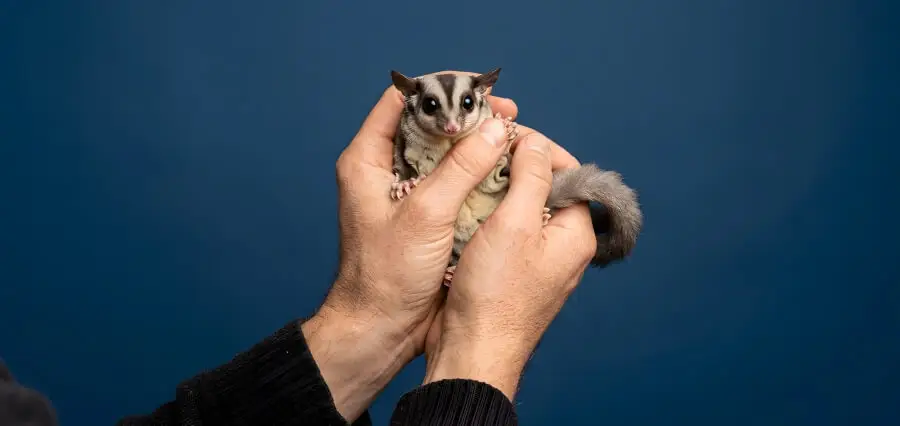
In Consultation with Pouchmates
There is a moment many new sugar glider owners experience during the first few days.
You have prepared the enclosure, bought the food, set up sleeping pouches and spent hours reading about bonding. Then your new glider arrives and seems completely uninterested in becoming your friend.
It may hide when you approach. It may make a sharp crabbing sound from inside its pouch. It might hesitate to take food from your hand or retreat the moment you move too quickly.
For someone who has seen videos of sugar gliders sleeping comfortably in an owner’s hoodie or climbing happily over their shoulders, this can feel disappointing.
But there is an important reality behind those videos:
Trust usually comes before affection, and trust takes time.
A sugar glider that has just arrived in a new home is experiencing unfamiliar smells, sounds, people, routines and surroundings all at once. Expecting an immediate bond can place unnecessary pressure on both the animal and the owner.
Understanding what bonding actually looks like can make those first few weeks much easier.
Start by Looking at the Situation From the Glider’s Side
Imagine being moved into an unfamiliar room where everything around you is several times your size.
You do not understand the language being spoken. You do not know whether the person reaching toward you is safe. Even the smells around you are unfamiliar.
That is roughly the situation a newly rehomed sugar glider is trying to process.
Sugar gliders are small, nocturnal marsupials. They are also highly social animals that naturally live with other sugar gliders rather than independently. Veterinary guidance from the Merck Veterinary Manual notes that they generally do better when kept in compatible pairs or small groups.
This social nature is one reason they can form meaningful relationships with people.
But being social does not mean automatically trusting every person they meet.
Trust has to be learned.
Crabbing Doesn’t Mean Your Sugar Glider Hates You
One of the first behaviors that can surprise new owners is crabbing.
The sound can be dramatic, especially when it comes from a tiny animal hidden inside a sleeping pouch.
It is easy to interpret it personally:
“My glider doesn’t like me.”
Often, that is not what is happening.
A newly arrived glider may simply be communicating discomfort or uncertainty.
Something has approached its sleeping area. A hand has moved nearby. A strange smell has entered its safe space.
The useful question is not:
“How do I make this behavior stop immediately?”
It is: “What is making my glider uncomfortable, and how can I make my presence more predictable?”
That change in mindset makes bonding much less stressful.
Bonding Is Usually Made Up of Small, Boring Moments
People naturally notice milestones.
- The first time the glider takes food from your fingers.
- The first time it voluntarily climbs onto your hand.
- The first time it falls asleep against you.
- Those moments are memorable.
- But the relationship is usually built during much less exciting interactions.
- Sitting quietly nearby.
- Offering food without chasing the animal around the enclosure.
- Speaking softly enough that your voice becomes familiar.
- Moving your hand slowly rather than reaching suddenly.
- Returning at roughly the same time each evening.
- Allowing the glider to investigate you rather than forcing contact.
- None of these things looks particularly impressive on social media.
Together, however, they teach something important:
This person behaves predictably, and nothing bad happens when they are nearby.
That is the foundation of trust.
Work With Their Schedule, Not Yours
Sugar gliders are nocturnal.
That matters more than many new owners initially realize.
For humans, this requires some adjustment.
You may want to interact with your glider at 2 p.m.
Your glider may strongly disagree.
Bonding often becomes easier when owners stop trying to fit the animal entirely into a human timetable.
Evening interaction generally gives you a better opportunity to observe natural behavior—climbing, exploring, playing and investigating.
A Bonding Pouch Can Help—but It Isn’t Magic
Bonding pouches are commonly used because they allow the glider to become accustomed to a person’s scent and movement while remaining inside a protected space.
They can be useful. But putting a frightened animal inside a pouch does not automatically create trust. The experience still needs to feel safe. If every interaction involves being grabbed, restrained or disturbed, carrying the glider around longer is unlikely to solve the underlying problem. Think of the pouch as one tool in a much larger process. The goal is familiarity. Your smell becomes familiar. Your voice becomes familiar. The rhythm of your movement becomes familiar. Eventually, your presence stops feeling like a new event. That is when bonding often begins to feel noticeably different.
Food Can Build Positive Associations—Without Becoming a Bribe for Everything
Food is naturally useful during bonding.
A small appropriate treat offered calmly can help an animal associate your presence with something positive. But there is a difference between using food thoughtfully and trying to buy cooperation every few minutes.
Nutrition matters significantly in sugar gliders. VCA Animal Hospitals notes that improper diets are associated with problems including obesity and nutritional disease, and cautions against relying on sugary treats simply because gliders enjoy them.
Treats should therefore remain small and appropriate within the animal’s overall feeding plan. Sometimes the most useful bonding interaction is simply offering something calmly and then allowing the glider to decide whether to approach.
That choice matters.
Don’t Make Every Interaction About Being Held
Owners naturally want to hold their pets. Sugar gliders may have other priorities. They may want to climb your sleeve. Investigate your hair. Sit behind your neck. Explore the room. Return to their pouch.
Take a treat and immediately leave. All of those interactions can still be part of bonding. A sugar glider does not need to sit motionless in your hand for twenty minutes to prove that it trusts you.
In fact, confidence often shows itself through exploration. An animal that comfortably moves around you, returns to you and investigates without immediately retreating may be showing significant trust even if it does not enjoy conventional “cuddling.”
Remember That Another Sugar Glider Matters Too
Human interaction is important, but sugar gliders are strongly social with their own species. So as a goal, always try to start with two or more gliders at a time.
Merck’s current veterinary guidance recommends keeping compatible sugar gliders in pairs or small groups when possible and notes that inadequate social conditions can contribute to behavioral problems.
That means bonding with a human and having appropriate glider companionship are not competing goals. They are different relationships. Keeping two compatible gliders does not necessarily prevent them from bonding with their owner. For many animals, feeling socially secure may actually make exploring and interacting with people easier.
Don’t Compare Your Week Two With Someone Else’s Year Three
This may be the hardest lesson. Search online and you will find sugar gliders sleeping in pockets, responding to their names, jumping between family members and calmly travelling in bonding pouches.
What you usually do not see is everything that happened before that video. You do not see the nervous first week. You do not see the owner sitting next to the enclosure night after night. You do not see the failed interactions. You do not know whether the animal had been handled regularly before arriving.
Individual gliders can also have very different personalities. One may investigate a new person within days. Another may need considerably longer.
Trying to force the second animal to behave like the first usually creates more frustration than progress.
Learn the Difference Between Slow Bonding and a Welfare Problem
Patience is useful. Ignoring warning signs is not.
Changes such as persistent self-injury, excessive grooming, significant fur loss, unusual pacing, loss of appetite, marked lethargy or other concerning behavioral changes should not simply be labelled “bonding issues.”
Veterinary literature notes that behavioral changes in sugar gliders can be associated with social stress, inappropriate housing and underlying health problems.
If something appears medically or behaviorally concerning, an animal veterinarian familiar with sugar gliders is the appropriate next step.
Finding that veterinarian before an emergency happens is also sensible. Merck recommends routine veterinary care and annual examinations for pet sugar gliders.
What Progress Actually Looks Like
Bonding progress is often subtle.
You may notice that your glider:
- stops retreating every time you enter the room;
- takes food while you remain nearby;
- investigates your hand voluntarily;
- settles more quickly after hearing your voice;
- climbs onto you without being picked up;
- spends longer exploring around you;
- returns to you after moving away; or
- begins sleeping comfortably while being carried.
None of these behaviors needs to happen on a particular timetable.
What matters is the overall direction.
Is the animal becoming calmer?
More curious?
More willing to approach?
More predictable around you?
Those changes usually matter more than whether you have reached a particular bonding milestone by week two or week four.
Responsible Ownership Begins Before the Bond
There is an understandable tendency to focus on the emotional side of sugar glider ownership. They are unusual animals. They are expressive. And the idea of forming a close relationship with one is part of their appeal. But bonding works best when the foundations are already right.
Appropriate companionship. Suitable housing. A secure sleeping area. Proper nutrition. Night-time enrichment. Access to an animal veterinarian that will see sugar gliders. And an owner willing to learn the species rather than expecting the species to adapt completely to them.
Resources dedicated specifically to sugar glider education, including Pouch Mates, can be useful starting points when researching these requirements before bringing gliders home. They should sit alongside veterinary guidance and individual professional advice rather than replacing them.
The Goal Isn’t to Make Your Sugar Glider Trust You Quickly
It is to give it enough consistent evidence that trusting you is safe.
That distinction changes the entire bonding process.
Instead of asking:
“Why isn’t my sugar glider bonded to me yet?”
Try asking:
“What happened today that made my glider slightly more comfortable around me?”
Maybe it took a treat without retreating.
Maybe it climbed onto your sleeve.
Maybe it stopped crabbing sooner than yesterday.
Maybe nothing dramatic happened at all.
That is okay.
Relationships with animals are rarely built through one breakthrough moment.
More often, they are built through dozens of ordinary interactions that gradually become familiar.
And eventually, the animal that once disappeared into its pouch when you approached may be the same one that chooses to climb onto you when the cage door opens.
The important word there is chooses.
That is what makes the bond meaningful.
Sources and Further Reading
- Merck Veterinary Manual — Unique Needs of Sugar Gliders
- Merck Veterinary Manual — Providing a Home for a Sugar Glider
- Merck Veterinary Manual — Overview of Sugar Gliders
- Merck Veterinary Manual — Diseases and Syndromes of Sugar Gliders
- Merck Veterinary Manual — Routine Health Care of Sugar Gliders
- VCA Animal Hospitals — Sugar Gliders: Feeding
Animal-care disclaimer: This article provides general educational information and is not a substitute for individual veterinary advice. Owners concerned about a sugar glider’s health, nutrition or behavior should consult a veterinarian experienced in exotic-animal medicine.