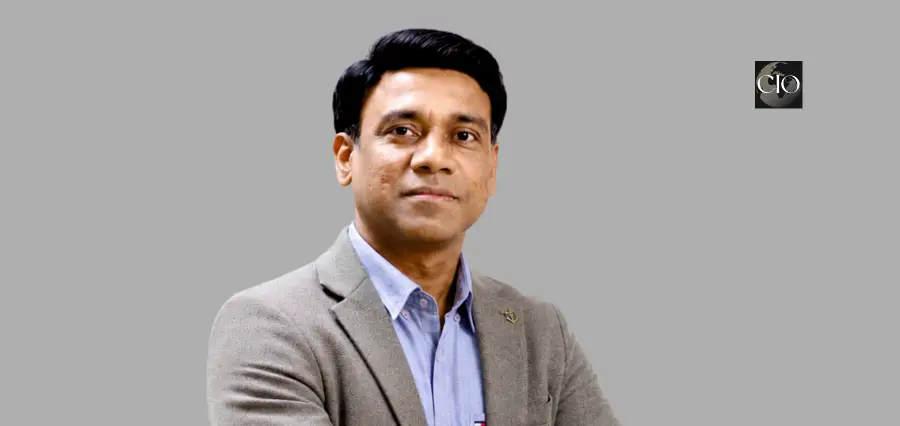
He started behind the scenes. Not in a grand strategy room or a corner office, but in an administrative role in the late 1990s before he joined Centena Group, handling the kind of work that keeps organizations running but rarely earns recognition. Shaji Abdul Kadar did not arrive in operations through a prestigious graduate program or an accelerated leadership track. He arrived through patient observation, steady evolution, and a willingness to cross into unfamiliar territory every time a new opportunity appeared.
That willingness, tested repeatedly over more than two decades, has taken him from the administrative back office to the Executive Board of Centena Group and the COO chair at ScreenCheck, one of the region’s most established value-added distributors and turnkey system integrator specializing in Security & Identification, Access Control, RFID, Physical security, Video surveillance, IP Audio & Intercom systems, UPS and data-centre solutions. Today, he oversees operations in a technology-driven, highly regulated industry spanning secure identity, physical security, and national identity infrastructure across the Middle East & Africa. The complexity is substantial, and so is the responsibility. Both, he will tell you, were built one stage at a time.
A Journey Built on Layers
Shaji describes his path not as a series of calculated career moves but as an accumulation of layers, each adding a dimension of understanding that the previous role alone could not have provided. The early administrative years gave him visibility into how a business functions at every level, from finance and procurement to compliance and customer service. When the opportunity came to move into sales and project delivery, he embraced the opportunity to expand his expertise beyond his original functional responsibilities.
Sales changed how he saw business fundamentally. He notes, “Sales taught me that technical knowledge and operational excellence mean little unless you understand what the customer truly values. I learned to listen deeply, negotiate, and to connect execution with outcomes.” The negotiation skills, the customer empathy, and the commercial instincts he developed in that period became foundational to how he later approached operational leadership. By the time he moved into increasingly senior operational roles, managing complex and multi-market portfolios, he carried a perspective that few purely operational leaders possess: an understanding of what clients need, what delivery requires, and how to hold both in alignment simultaneously.
His appointment to the Executive Board of Centena Group in 2019 was, in his own telling, both an acknowledgment of that accumulated experience and the beginning of a new kind of responsibility. He reflects, “Each phase taught me something unique: humility from my early roles, adaptability from sales, and systems thinking from operations. Together, they shaped my approach to leadership today.” The step into the COO role at ScreenCheck followed as a natural progression, a culmination of years spent learning every layer of the business from the inside.
Values That Hold Under Pressure
In high-stakes operational environments, where project timelines are measured in dirhams and delivery failures carry both commercial and reputational consequences, the question of what a leader actually stands for becomes practical rather than philosophical. Shaji is direct about his answers. Integrity is non-negotiable, not as an aspiration but as a daily operating standard. He states, “Trust is your strongest currency. Whether you’re managing multimillion-dirham projects or small teams, people respect honesty more than perfection.”
Accountability sits alongside integrity in his framework. Taking genuine ownership of both success and failure, without deflecting or minimizing, is what earns the deepest respect from the teams he leads. Servant leadership completes the picture: his role, as he defines it, is not to be the most capable person in every room but to create the conditions in which others can perform at their highest level. He adds, “When you face challenges with calm confidence and optimism, it sets up the tone for the entire team. Teams mirror their leaders, which makes composure under pressure one of the most practically important things a leader can cultivate.”
Operational Excellence Across a Diverse Region
The Middle East is not a single market. It is a collection of distinct economies, regulatory environments, procurement cultures, and operational realities that vary significantly from country to country. What works in the UAE requires meaningful adaptation in Oman, Saudi Arabia and Qatar. Shaji has built his operational approach around navigating that diversity without sacrificing the consistency that enterprise clients require, and regulators demand.
Process discipline provides the foundation: clear workflows, defined accountability mechanisms, and standards that hold across geographies. He explains, “You can’t improve what you don’t measure, so we use performance dashboards and regular reviews to track outcomes and adapt quickly.” Local understanding provides intelligence: hiring and genuinely empowering local talent who understand the nuances of each market produce results that no amount of centralized expertise can replicate. Cross-market collaboration provides the multiplier: teams across the region exchanging best practices so that an innovation that improves operations in one country benefits all. He sums up the philosophy simply: “Operational excellence is less about control and more about alignment. Getting everyone to move with the same rhythm, even if they are dancing to slightly different tunes.”
When the Plan Changes Overnight
One of the clearest examples of Shaji’s leadership under pressure came during the implementation of a government identity project in a GCC country. Midway through the project, the team faced two major operational challenges at once. New regulatory requirements demanded the rapid localization of data infrastructure and workflows, while global supply-chain disruptions delayed the delivery of critical hardware. These challenges emerged at a particularly sensitive stage, putting both delivery milestones and client confidence at risk.
Shaji responded quickly with a clear and structured plan. He formed a cross-functional task force comprising operations, legal, technical, and local partner teams, supported by specialists in the relevant areas. Daily war-room meetings ensured close coordination, rapid decision-making, and clear accountability.
“We engaged directly with the regulator, proposed a phased approach to compliance, and brought in experts to accelerate knowledge transfer,” Shaji recalls. “The crisis tested us, but it also revealed the strength of our team.”
Through direct and constructive engagement with the regulator, the team established a practical compliance pathway that protected the overall project timeline. More importantly, the localization capabilities developed during this period became a new operational standard for projects in other markets.
What could easily have developed into a serious delivery and reputational crisis was successfully contained—and ultimately transformed into a repeatable model for managing similar challenges across the region.
He reflects, “Every challenge hides an opportunity, if you are willing to stay calm, collaborate, and learn.”
Technology as an Enabler, not a Destination
ScreenCheck operates at the intersection of identity, security, and technology, a space that evolves faster than most enterprise environments. Shaji approaches technology from a consistent operating principle: it is an enabler of business outcomes, not a destination. He is direct on this point: “The key is to stay curious and never assume you’ve caught up. In technology, staying still is the fastest way to fall behind.”
Next-generation identity management, intelligent biometrics, edge computing, and AI-driven access control have all transformed what the company can deliver and how quickly. Automation of internal workflows, from service ticket management to procurement tracking and data reconciliation, has freed operational capacity for higher-value work. An internal R&D function experiments with emerging technologies and partners with global vendors to test what is viable before it becomes standard. Pilots with clients generate real-world feedback that shapes what gets scaled. The philosophy running through all of it is the same: curiosity is the only sustainable posture for an organization that competes on the strength of what it can do.
Building Teams That Outlast Their Leaders
The UAE’s operational environment is a study of multicultural complexity. Teams drawn from dozens of nationalities, with different professional backgrounds, communication styles, and motivational drivers, need sufficient common ground to operate with genuine cohesion under pressure. He is clear about where to start: “When people from different backgrounds share a common goal, they unite naturally. I ensure that every team member understands not just what we’re doing, but why it matters.”
Cultural fluency follows understanding what motivates individuals rather than applying a uniform management style to produce engagement that generic approaches cannot reach. Psychological safety sustains it, because innovation only emerges in environments where people can speak, challenge, and disagree without fear. Leadership development receives the same intentional attention. Promising managers are identified early and given a stretch of responsibilities that demand real decision-making. He notes, “We practice a transparent feedback culture, continuous, not annual. I encourage my managers to ask, ‘What can I do better?’ It’s a small question that fuels enormous growth.” The goal is explicit: to develop leaders who think independently but act collaboratively, who can carry the organization forward long after the current generation has moved on.
The Road Ahead
Looking across the next three to five years, Shaji sees several forces converging to reshape the GCC’s operational landscape. Digital identity and e-government ecosystems are expanding rapidly, moving from physical credentials to mobile-first infrastructure. AI and automation will become standard components of operational monitoring, predictive maintenance, and organizational decision-making. He observes, “Organizations that embrace data will run circles around those that rely on instinct alone.” Sustainability and ESG compliance will move from aspiration to regulatory expectation as GCC governments pursue their environmental goals. And the talent profile the region will need, combining technical depth with business acumen and cross-cultural fluency, will require organizations to fundamentally rethink how they develop their people.
His advice to aspiring COOs distills the same thinking that has guided his own career: “Be curious, be consistent, and be courageous. Don’t chase titles; chase learning. Every role you take is preparing you for something bigger, even if you can’t see it at the time.” For Shaji, the through line across all those changes remains the same principle that shaped him in that administrative back office more than two decades ago: leadership is not about having all the answers. It is about building the systems, the teams, and the culture that they can find.