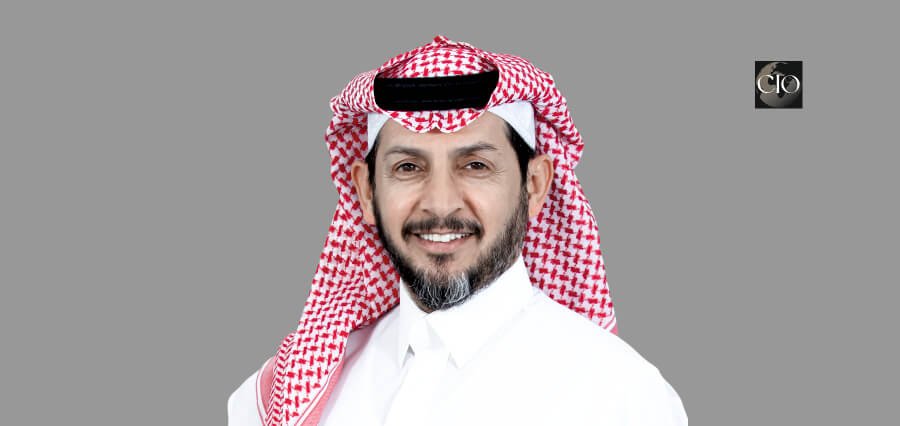
The existence of true leadership types exists because some leaders operate institutions while others lead institutional transformations. Eng. Khaled Al Qureshi belongs firmly to the second category. The chemical engineer who became Chief Executive Officer in 2017 has managed SHARAKAT, which used to be known as Saudi Water Partnership Company (SWPC), since its establishment. The organization has achieved major infrastructure projects through his leadership, which he has maintained with steady control. Al Qureshi’s professional history shows that he has achieved national development through his work, which has generated over USD 15 billion in projects and brought between USD 38 billion and USD 53 billion to the Kingdom’s GDP.
The man who exists as himself avoids all forms of excessive self-importance. He uses measured speech patterns to deliver his thoughts about important life events, which he defines with terms that explain his devotion to three groups: his country, his team, and the citizens who depend on clean water.
A Journey Three Decades in the Making
Al Qureshi’s story begins not in a boardroom but in the field. In 1994, the same year he earned a Bachelor of Science in Chemical Engineering from King Saud University, he joined the Saline Water Conversion Corporation (SWCC), the state body responsible for one of the most water-scarce nations on earth, producing enough desalinated water to sustain millions. It was a formative crucible.
“Success in a sector as vital as water is not only about technology, but also about the people who drive it,” he reflects. Those early years at SWCC instilled in him a rigorous operational discipline: a deep respect for process, a tolerance for complexity, and an understanding that the margin for error in water infrastructure is essentially zero.
He deepened his technical credentials in 2002, completing a Master of Science in Desalination Technology with a distinction from the University of Glasgow. The degree fed directly into a body of published research between 2002 and 2008 covering water desalination and cogeneration, cementing his standing not merely as a practitioner but as a contributor to the science he practiced.
From Operator to Strategist
After more than a decade building his operational foundations at SWCC, Eng. Khaled Al Qureshi made a decisive pivot. He joined Marafiq as Vice President of Operations and Maintenance, a role that elevated him from managing plants to managing enterprises. At Marafiq, he oversaw the complete operation and maintenance of water and power utilities across Jubail and Yanbu, governing assets valued at over USD 5.3 billion.
The numbers are striking enough, but the philosophy behind them tells the fuller story. He launched professional development programs that reached more than 1,500 employees, treating workforce investment not as a cost line but as a strategic multiplier. He simultaneously drove energy efficiency initiatives that generated measurable reductions in capital and operating expenditure, delivering what the infrastructure world terms ‘sustainable economic value’ but which, in plain terms, meant doing more with less and leaving the assets stronger than he found them.
“Leadership is not defined by individual achievement, but by the ability to inspire teams to deliver lasting impact,” he says.
This dual fluency in operational detail and enterprise strategy would prove decisive when, in 2017, the Kingdom called on him for a far larger assignment.
Building a National Water Model
When Eng. Khaled Al Qureshi assumed the CEO role at SHARAKAT, he inherited a mandate as ambitious as it was uncharted: to design, lead, and deliver Saudi Arabia’s water-sector privatization program through Public-Private Partnerships and to do so in a way that attracted global capital while keeping tariffs among the lowest on earth.
Under his stewardship, SHARAKAT has successfully closed more than 20 projects spanning water desalination, wastewater treatment, water transmission, and strategic storage. The organization has built a forward pipeline of over 50 diversified projects. More than 25 local and international investors have committed to the program, a vote of confidence in the governance architecture that he and his team constructed from the ground up.
The local content story is equally compelling. Across different project phases from design and procurement through to construction and operations, the organization’s projects have achieved localization rates between 40 and 70 percent. That translates directly into domestic industry growth, local talent development, and accelerated technology transfer, precisely the outcomes that Saudi Arabia’s Vision 2030 framework demands.
The social dimension of the portfolio deserves a mention. The firm projects support water supply reliability for the Holy Sites, serving the millions of pilgrims who visit Makkah and Madinah annually, an undertaking where operational failure is simply not an option.
“Our ambition is for Saudi Arabia to emerge as a global benchmark in sustainable water management, technologically advanced, economically robust, and environmentally responsible,” he says.
The Architecture of Success: Transparency and Trust
When asked Eng. Khaled Al Qureshi to explain SHARAKAT’s track record, he returns, consistently, to two words: transparency and trust. He describes them not as corporate values displayed on a lobby wall but as structural design principles baked into every procurement process and every partner engagement.
“From the outset, SHARAKAT’s role was never limited to contract execution; it was about building a national model that combines private-sector efficiency with public-sector accountability,” he explains. Open, fair, and internationally recognized procurement processes formed the first pillar, ensuring that local and global investors entered each program with confidence in the rules of engagement.
The results validate the approach. SHARAKAT has delivered some of the lowest water and wastewater tariffs in the world. Projects such as the Shuaibah-3 desalination conversion to Reverse Osmosis technology stand as a global reference point, proof that a Gulf state can move fast, adopt cutting-edge technology, and do so without sacrificing financial discipline.
“Success is not measured by numbers alone, but by how deeply our partners feel part of a shared national journey, one that serves people before infrastructure,” he says. It is a distinction that separates transaction managers from institution builders, and he operates firmly in the latter category.
Leadership Forged Under Pressure
Eng. Khaled Al Qureshi is candid about the moment that sharpened his leadership philosophy most acutely. Early in his career, a major plant he was overseeing faced a sudden operational crisis, one severe enough to halt the facility entirely. The clock was running, the stakes were national, and the temptation to opt for a quick, costly patch was real.
He chose differently. He convened his team with full transparency, built a detailed recovery plan, and worked around the clock until the facility came back online — not merely restored but running more efficiently than it had before.
“That experience taught me that leadership is not about controlling the situation, but about giving people the confidence to overcome it. Resilience does not mean compromise — it means adapting without losing direction,” he says.
The lesson embedded itself permanently: every challenge that followed became, in his framing, raw material for organizational growth rather than a threat to survival. It is a mindset that permeates SHARAKAT’s culture, and that helps explain how the organization has moved through complex, multi-billion-dollar procurements in a sector where technical, regulatory, and geopolitical variables rarely stand still.
Sustainability As Foundation, Not Finish Line
Regarding sustainability, Eng. Khaled Al Qureshi pushes back against what he sees as a common misconception: the idea that environmental responsibility competes with financial performance. At SHARAKAT, he insists, the two are inseparable.
“Environmental and economic sustainability are two sides of the same coin: financial success means little if it comes at the cost of the environment, and green solutions are meaningless if they cannot endure financially,” he argues. His organization backs that position with action: adopting low-emission desalination technologies, investing in energy efficiency, and reusing treated water across developmental applications.
Digital transformation sits alongside sustainability as the second defining pillar of SHARAKAT’s operating model. Eng. Khaled Al Qureshi describes technology not as a productivity tool but as a quality-of-life multiplier. Smarter water management reduces costs and conserves resources simultaneously, and it aligns with Saudi Arabia’s Vision 2030 targets on carbon reduction, energy diversification, and long-term water security.
Every project that leaves his desk begins with a single governing question: Will this still add value to future generations? It is, he acknowledges, an unusual lens for an infrastructure organization to apply at the start of a procurement cycle rather than the end. But it is, he argues, exactly the right one.
The Talent Imperative
If there is one challenge that Eng. Khaled Al Qureshi returns to with particular urgency, it is talent, not its scarcity, but the evolving nature of what talent demands from the organizations that seek it.
“Today’s professionals seek meaning, growth, and inspiration, not merely employment,” he observes. For a leader operating at the intersection of public infrastructure and private capital, that observation carries practical weight. SHARAKAT’s mandate requires people who can navigate technical complexity, commercial negotiation, and regulatory sensitivity simultaneously. Attracting and retaining that caliber of professional demands more than competitive compensation; it demands a culture.
Eng. Khaled Al Qureshi has invested heavily in building exactly that: a workplace grounded in transparency, initiative, and personal accountability. He has embedded an environment where creative thinking is actively rewarded and where people are trusted to make consequential decisions rather than waiting for direction from the top.
“While performance metrics matter, true leadership ultimately begins and ends with people,” he says. The observation is simple enough to dismiss as a platitude until one examines the workforce development track record he built at Marafiq and has continued at SHARAKAT. Then it reads as a proven operating principle.
A Vision Aligned with the Kingdom’s Ambitions
Eng. Khaled Al Qureshi speaks about Vision 2030 with the authority of someone who has been translating it into steel, concrete, and operating contracts for the better part of a decade. According to him, the national transformation agenda represents a genuine inflection point, a moment when Saudi Arabia chose to place people and resources, rather than hydrocarbons alone, at the centre of its development story.
SHARAKAT’s contribution to that story runs into billions of Saudi Riyals across projects that touch water, food, and energy security simultaneously. The organization is currently progressing a portfolio of projects that will shape the Kingdom’s infrastructure for generations.
The Balanced Leader
For all the scale of his professional responsibilities, Eng. Khaled Al Qureshi makes an unexpected argument: that effective leadership requires discipline to pause. Amid the relentless pace of a national infrastructure program, he has learned that strength does not come from constant motion but from the capacity to step back and recalibrate.
He draws sustenance from two sources above all others: his team, from whom he says he learns daily, and his family, who provide the stability that makes sustained performance possible. Balance, in his definition, is not about dividing time equally between work and life; it is about giving each its due attention at the right moment.
“When professional and personal life align in harmony, work becomes a passion rather than a burden and leadership becomes the art of being balanced enough to bring balance to others,” he says. It is a philosophy that speaks to the whole person rather than merely the executive, and it may explain, more than any strategy document, why the culture he has built at SHARAKAT has proven durable under pressure.
A Message Worth Hearing
For young professionals beginning their careers in an era of accelerating change, Al Qureshi’s counsel is deliberately counter-cultural. In a world that rewards speed and visibility, he advises them to listen first.
He believes that ambition must be paired with patience and discipline. According to him, leadership is not a straight path but a series of challenges that shape individuals before elevating them. He emphasizes that mistakes serve as valuable lessons, teams must be empowered, and shared success should always be celebrated.
He reserves his most direct message for last: values matter more than competence. Skills, he notes, can be taught. Integrity cannot.
“If purpose comes before position, leadership will find you before you seek it,” he says.
In the story of Saudi Arabia’s water sector, a story of scarce resources, bold ambition, and the engineering of abundance, Eng. Khaled Al Qureshi has been one of its most consequential authors. He writes not in headlines but in pipelines, partnerships, and the quiet confidence of a leader who has always known that the most enduring structures are the ones built with both precision and purpose.